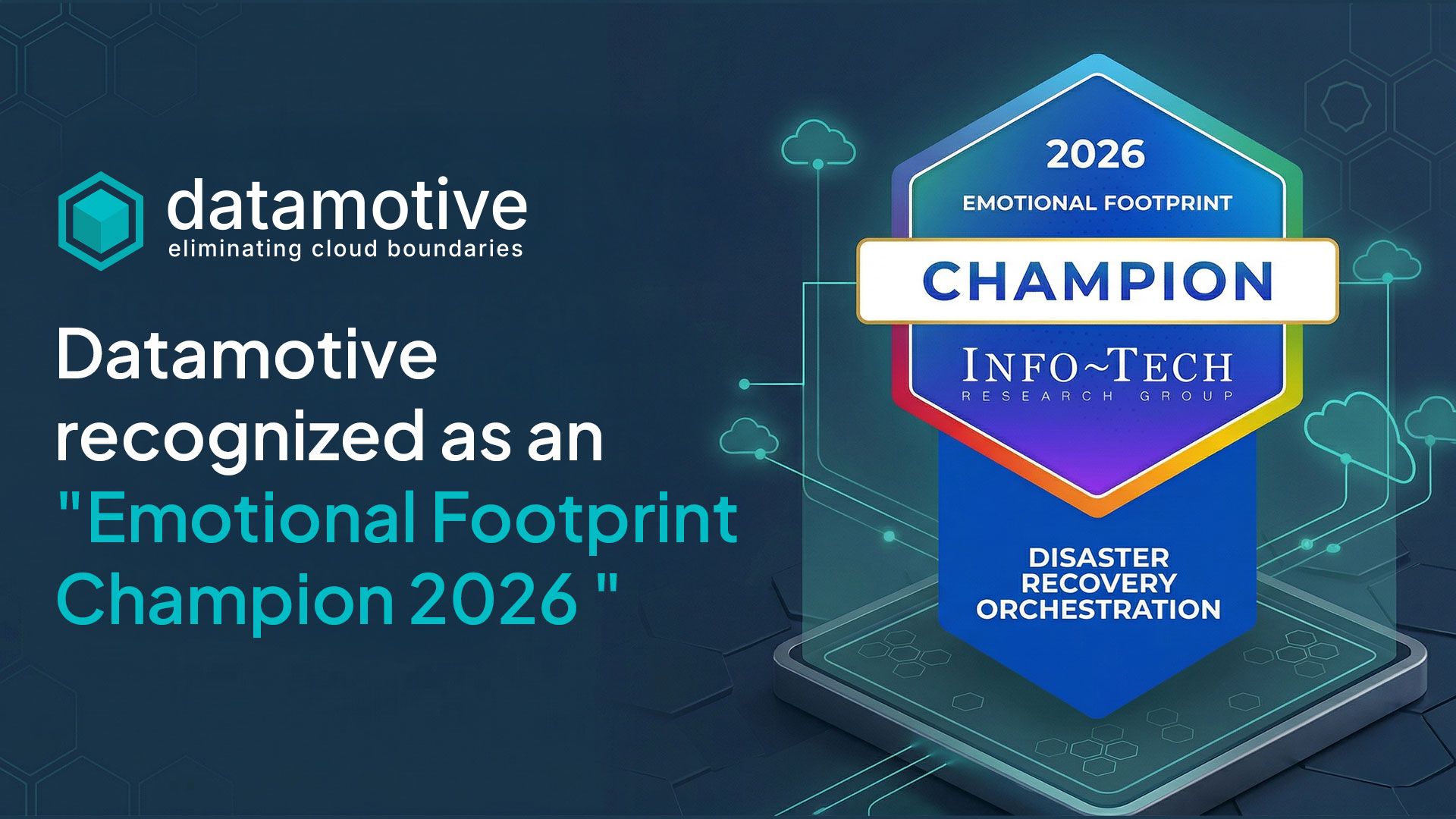
Datamotive has been recognized as an Emotional Footprint Champion 2026 in the Disaster Recovery Orchestration category by SoftwareReviews, an achievement that reflects not just product capability, but how customers experience the platform in real-world environments. Unlike traditional analyst evaluations, this recognition is based entirely on verified end-user feedback, measuring trust, reliability, support, and overall satisfaction. In disaster recovery, where outcomes matter more than intent, these factors define true value.
This recognition highlights a shift in how enterprises evaluate disaster recovery solutions. Organizations are moving beyond feature comparisons and focusing on outcomes: predictability, simplicity, and confidence. Recovery capability is expected; assurance is what differentiates platforms.
Datamotive stood out across key customer-centric areas:
Service Experience — Smooth onboarding and strong alignment with business needs
Service Experience — Smooth onboarding and strong alignment with business needs
Product Impact — Reduced complexity with predictable recovery outcomes
Product Impact — Reduced complexity with predictable recovery outcomes
Strategy & Innovation — Alignment with hybrid and multi-cloud environments
Strategy & Innovation — Alignment with hybrid and multi-cloud environments
Vendor Support — High responsiveness in critical scenarios
Vendor Support — High responsiveness in critical scenarios
Conflict Resolution & Negotiation — Transparent and customer-focused approach
Conflict Resolution & Negotiation — Transparent and customer-focused approach
This contrasts with traditional DR tools that often rely on complex, agent-heavy architectures and fragmented workflows, creating operational overhead.
Datamotive’s approach focuses on simplicity and predictability through:
Agentless, hypervisor-agnostic architecture
Agentless, hypervisor-agnostic architecture
Incremental failover and failback
Incremental failover and failback
Predictable recovery SLA of 10 min.
Predictable recovery SLA of 10 min.
As enterprises adopt hybrid and multi-cloud strategies, disaster recovery is now a core operational capability.
The future of disaster recovery will be defined not just by how systems recover, but by how confidently organizations can rely on that recovery.
Stay up-to-date with latest content from Datamotive
Why Regulators Expect Proven Recovery, Not Backup Claims Regulators are no longer satisfied with backup claims alone. Modern compliance frameworks require organizations to demonstrate proven disaster recovery through tested failover, validated RTO/RPO objectives, and auditable recovery processes. This article explores why regulatory expectations are shifting from data retention to operational resilience and how enterprises must design recovery architectures that provide measurable, repeatable, and compliance-ready recovery outcomes. continue reading...
Why Regulators Expect Proven Recovery, Not Backup Claims
Regulators are no longer satisfied with backup claims alone. Modern compliance frameworks require organizations to demonstrate proven disaster recovery through tested failover, validated RTO/RPO objectives, and auditable recovery processes. This article explores why regulatory expectations are shifting from data retention to operational resilience and how enterprises must design recovery architectures that provide measurable, repeatable, and compliance-ready recovery outcomes.
How Datamotive Enables Cloud-Agnostic Disaster Recovery for Nutanix Workloads Enterprises running Nutanix need disaster recovery strategies that go beyond platform dependency. This article explores how cloud-agnostic disaster recovery enables Nutanix workloads to recover predictably across hybrid and multi-cloud environments. Learn how automated failover and failback, compliance-ready validation, and hypervisor-agnostic orchestration help organizations protect business continuity without vendor lock-in or infrastructure symmetry constraints. continue reading...
How Datamotive Enables Cloud-Agnostic Disaster Recovery for Nutanix Workloads
Enterprises running Nutanix need disaster recovery strategies that go beyond platform dependency. This article explores how cloud-agnostic disaster recovery enables Nutanix workloads to recover predictably across hybrid and multi-cloud environments. Learn how automated failover and failback, compliance-ready validation, and hypervisor-agnostic orchestration help organizations protect business continuity without vendor lock-in or infrastructure symmetry constraints.
Beyond Recovery: Building True Disaster Risk Resilience Today, resuming operations isn’t enough. True competitiveness depends on how seamlessly an enterprise can withstand, adapt to, and recover from disruption—without compromising business objectives. This evolution marks the shift from recovery to resilience: recovery gets you back up; resilience ensures you never truly fall. continue reading...
Beyond Recovery: Building True Disaster Risk Resilience
Today, resuming operations isn’t enough. True competitiveness depends on how seamlessly an enterprise can withstand, adapt to, and recover from disruption—without compromising business objectives. This evolution marks the shift from recovery to resilience: recovery gets you back up; resilience ensures you never truly fall.
Need more information?